Languages

Extinction of Species

Extinction of Species

English

Organised crime and Asian superstition driving rhinos and elephants to extinction

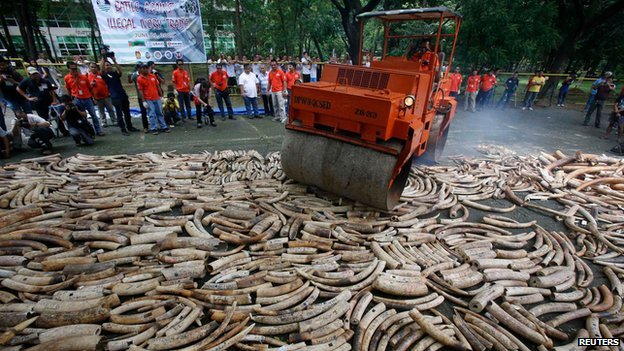
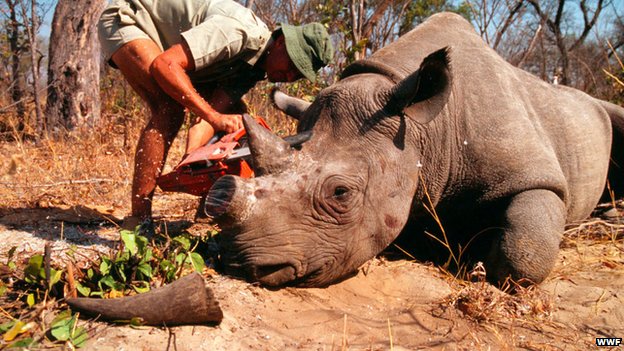
Ivory destruction Despite efforts to destroy ivory, criminals are becoming more organised, ingenious and dangerous. "We have seen more and more organised crime networks moving into the wildlife trade," says Davyth Stewart from Interpol, the international intelligence agency. "Groups who have been traditionally involved in drug trafficking, fire arms and human trafficking are now moving onto wildlife." It's clearly not a fair match: conservationists pitted against criminal gangs. But the wildlife experts say it's a fight they have to take on. They have gathered at the Zoological Society of London to tackle how to halt the rapidly growing trade in animals. The backdrop to these crisis talks is bleak. Thousands of rhinos, elephants, tigers and others have been slaughtered, becoming part of an illegal market that's worth an estimated $19bn a year. Many criminals see it as low risk, high profit, says Mr Stewart. "There is a lower risk of apprehension, it's unfortunate but law enforcement has not invested the resources in attacking wildlife crime as it has in other crimes," he explains. "Even in courts the penalties are much lower. Just last year in Ireland, we saw two people arrested for smuggling rhino horns worth half a million euros. They received a 500-euro fine." Demand and supply John Sellar, the former chief of enforcement at Cites (the Convention on International Trade in Endangered Species), says the focus of the battle should be shifted away from conservation towards the issue of criminality. "It's about locking up the bad guys," he tells the conference.

Killer starfish threaten Great Barrier Reef

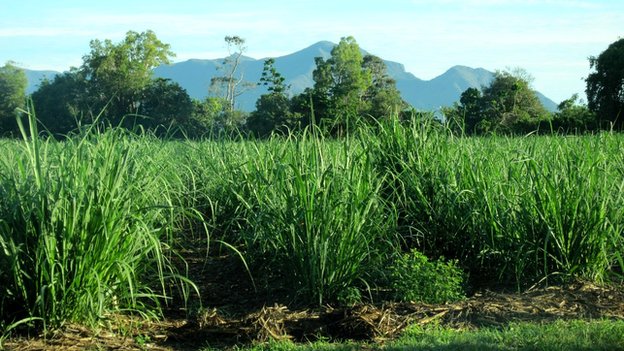
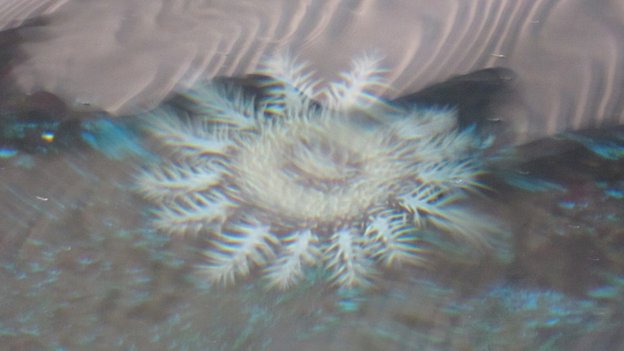
Killer starfish threaten Great Barrier Reef Crown-of-thorns starfish have a voracious appetite and waves of carnivorous starfish are eating their way through Australia's Great Barrier Reef - and sugar cane farming is being blamed. Researchers at Australia's Institute of Marine Science (AIMS), just outside Townsville, Queensland, in north-east Australia, have mapped the pattern of destruction. "Coral cover is half of what it was 27 years ago, coral cover is going down at an alarming rate." Dr Katharina Fabricius, coral reef ecologist and AIMS principal research scientist, told the BBC World Service programme Discovery. She said the biggest culprit was the Crown of Thorns Starfish (COTs). "There are three main sources for the coral decline, one is storms, however 42% is attributed to Crown of Thorns Starfish - and just 10% due to bleaching. This compares with 70% due to bleaching for reefs elsewhere in the world , such as in the Caribbean." “Crown of Thorns are very fecund animals - each female can produce between five and 20 million eggs ” John Brodie, James Cook University Bleaching occurs when corals are stressed by changes in conditions such as temperature, light, or nutrients. They expel the symbiotic algae living in their tissues, causing them to turn completely white. Australian scientists are now looking at ways to reduce the destruction wreaked by starfish, which have the ability to smother coral and digest the fleshy parts.

Critically Endangered Northern Hairy Nosed Wombat

Critically Endangered Northern Hairy Nosed Wombat

Critically Endangered Northern Hairy Nosed Wombat. Scientists believe the number left in the world is about 200 – a slight increase from the mid 1980s when there were only 35 – but the northern hairy nosed wombats remain critically endangered, largely because of competition with cattle and sheep for food, as well as drought and dingo and feral dog attacks. Today, approximately 185 northern hairy nosed wombats reside at Epping Forest in Queensland, Australia, and another 15 live in the 105-hectare Richard Underwood Nature Refuge nearby, making these the only northern hairy nosed colonies in the world. Northern hairy nosed wombats can only be found in the wild; their shy natures making the nocturnal marsupials ill-prepared to cope with the stress of captivity. There are two other species of wombat, the common (or bare-nosed) wombat, which is not endangered and is found on the southeastern coast of Australia (in New South Wales, Victoria and Tasmania) and the southern hairy nosed wombat, which is endangered and is found in arid, sandy pockets in the southern part of Australia (in South Australia and Western Australia). The Northern hairy nosed wombat is the largest of all the three species, weighing up to 40kg and measuring about 1m long (the females are slightly heavier than the males). Wombats are often referred to as the engineers of the mammal world. Their burrows can be up to 90m long and are essential for helping the animals regulate their temperature and hide from predators. Wombats generally live alone in their burrows, but sometimes there are more than one.

Amazon and Global Deforestation rose in 2013

Brazil says Amazon deforestation rose 28% in a year

Brazil Environment minister Izabella Teixeira
Minister Izabella Teixeira says she will tackle the problem with local authorities.

Brazil says the rate of deforestation in the Amazon increased by 28% between August 2012 and last July, after years of decline. The government is working to reverse this "crime", Environment Minister Izabella Teixeira said. Activists have blamed the increase in destruction on a controversial reform to Brazil's forest protection law. Last year Brazil reported the lowest rate of deforestation in the Amazon since monitoring began. The provisional statistics from August 2012 to last July suggest that the area suffering deforestation was 5,843 sq km (2,255 sq miles), compared to 4,571 sq km (1,765 sq miles) in the previous 12 months. The 28% rise interrupts a period of declining deforestation which began in 2009. However, it still remains the second lowest annual figure for forest loss in absolute terms. The worst year on record was 2004, when 27,000 sq km of forest was destroyed. Monthly data from several scientific institutions had suggested the deforestation rate might be on the rise.

Ocean Acidification caused by CO2 Emissions

Emissions of CO2 driving rapid oceanic acidification


Great barrier reef
Corals all over the world are threatened by rising rates of acidification in the oceans.
 

The world's oceans are becoming acidic at an "unprecedented rate", more rapidly than at any time in the past 300 million years. In their strongest statement yet on this issue, scientists say acidification could increase by 170% by 2100. They say that some 30% of ocean species are unlikely to survive in these conditions. The researchers conclude that human emissions of CO2 are clearly to blame. The study will be presented at global climate talks in Poland next week.

In 2012, over 500 of the world's leading experts on ocean acidification gathered in California. Led by the International Biosphere-Geosphere Programme, a review of the state of the science has now been published. This Summary for Policymakers states with "very high confidence" that increasing acidification is caused by human activities which are adding 24 million tonnes of CO2 to oceans every day.

Fossil fuel subsidies a reckless use of public funds

The world is spending half a trillion dollars on fossil fuel subsidies every year, according to a new report. The Overseas Development Institute (ODI) says rich countries are spending seven times more supporting coal, oil and gas than they are on helping poorer nations fight climate change. Fuel subsidies to US farmers amounted to $1bn in 2011 says the ODI. Some countries including Egypt, Morocco and Pakistan, have subsidies bigger than the national fiscal deficit. The new report calls on the G20 to phase out the payments by 2020. While there is no globally agreed definition of what a fossil fuel subsidy actually is, the report draws on a range of sources from the International Monetary Fund to the International Energy Agency. It details the range of financial help given to oil, coal and gas producers and consumers from national governments and through international development. What emerges is a complicated web of different types of payments in different countries. In the United States, for example, the government in 2011 gave a $1bn fuel tax exemption to farmers, $1bn for the strategic petroleum reserve and $0.5bn for oil, coal and gas research and development. Germany gave financial assistance totalling 1.9bn euro to the hard coal sector in the same year. And the UK gave tax concessions worth £280m in 2011 for oil and gas production. Pakistan is a country with the second highest number of children out of school in the world. It has some of the worst nutrition, maternal mortality and child health indicators.

Farming impact on Global Warming

Changing the way farmers plough their lands could have a big impact on global emissions of greenhouse gases. Changing farming practices could play an important role in averting dangerous climate change says the UN. In their annual emissions report, they measure the difference between the pledges that countries have made to cut warming gases and the targets required to keep temperatures below 2C. On present trends there is likely to be an annual excess of 8 to 12 gigatonnes of these gases by 2020. Agriculture, they say, could make a significant difference to the gap. This is the fourth such report, compiled by the United Nations Environment Programme (Unep) in conjunction with 44 scientific groups in 17 countries. It says the world needs to reduce total emissions to 44 gigatonnes of carbon dioxide equivalent by 2020 to keep the planet from going above the 2C target, agreed at a UN meeting in Cancun in 2010. But when all the pledges and plans made by countries are added together, they show an excess of between 8 and 12 gigatonnes per annum in seven years time, very similar to last year's report. To put it in context, 12 gigatonnes is about 80% of all the emissions coming from all the power plants in the world right now. The authors highlight a number of ways in which this gap can be closed, including tightening the rules for counting emissions and expanding the scope of pledges already made. They believe around half the gap could be closed in this way.

Japan dolphins and other sea species 'face extinction'

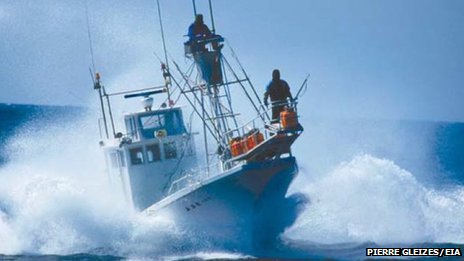
Japan dolphins and other sea species 'face extinction' The EIA says that dolphins are trapped and then sold to aquaria or slaughtered for consumption Japan's hunting of dolphins, smaller whales and porpoises is threatening some species with extinction in its coastal waters, a report by a British environmental group has said. The Environmental Investigation Agency (EIA) report says that more than a million such creatures have been killed in Japanese hunts in the past 70 years. It says that each year thousands are killed despite conservation concerns. The Japanese government has not commented on the report. But it has consistently defended its coastal whaling as a longstanding tradition, a source of livelihood and necessary for scientific research. The government has also argued that small cetaceans should be excluded from the International Convention on Whaling. 'Grave concerns' The BBC's Rupert Wingfield-Hayes in Tokyo says that the Japanese practice of driving many dolphins and porpoises onto beaches to be slaughtered has drawn international condemnation. Japanese hand-harpoon hunting vessel The EIA says that porpoises, dolphins and small whales are often chased until they become exhausted and within range of hand-held harpoons. The EIA says that it is also unsustainable, and a danger to human health. Studies have found high levels of mercury and industrial chemicals like PCBs in dolphin and porpoise meat. One study found people living in one dolphin-eating community in central Japan have mercury levels five times higher than normal.

New species of dolphin identified - 2013

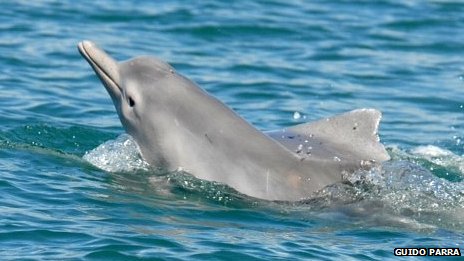
New species of dolphin identified. A team of researchers says it has identified a new species of humpback dolphin. Physical and genetic evidence suggests that cetaceans found in waters off northern Australia are distinct within the humpback family. This general group grows up to 2.4m in length and inhabits coastal waters from the Atlantic to the Pacific. The evidence for the distinct species in northern Australia is outlined in the academic journal Molecular Ecology. "Based on the findings of our combined morphological and genetic analyses, we can suggest that the humpback dolphin genus includes at least four member species," said co-author Martin Mendez, from the Wildlife Conservation Society's Latin America and the Caribbean programme. Dr Mendez added: "This discovery helps our understanding of the evolutionary history of this group and informs conservation policies to help safeguard each of the species." New species scheme for humpback dolphins: Atlantic humpback dolphin (Sousa teuszii), which occurs in the eastern Atlantic off West Africa An Indo-Pacific humpback dolphin (Sousa plumbea), which ranges from the central to the western Indian Ocean Another species of Indo-Pacific humpback dolphin (Sousa chinensis), inhabiting the eastern Indian and western Pacific Oceans Fourth Sousa species found off northern Australia yet to be named The authors analysed physical data gathered mostly from beached dolphins and museum specimens.

Just 227 tree species dominate Amazon - 11,000 endangered tree species

Just 227 tree species dominate Amazon

Researchers were surprised to find that such a small proportion of species dominated the Amazon . Despite being home to about 16,000 tree species, just 227 "hyperdominant" species account for half of Amazonia's total trees, a study suggests. An international team of researchers found that the region was, in total, home to an estimated 390 billion trees. Writing in Science, they added that the rarest 11,000 species made up only 0.12% of tree cover. However, they added that the new data could help unlock ecological secrets held by the biodiversity hotspot.

The results were based on a survey of 1,170 plots and half-a-million trees across the six-million-square-kilometre area, often described as the lungs of the world. The authors said that the underlying cause of the hyper dominance of the 227 species, which accounted for 1.4% of the estimated number of species in the region, remained unknown. "We knew that, normally, a few species dominate ecosystems, but if you have a system that has 16,000 tree species but just 227 make up half of the trees, that was pretty surprising even for us," said lead author Dr Hans ter Steege from the Naturalis Biodiversity Center in the Netherlands. He told the Science podcast: "We don't really know why these species are so incredibly dominant because they do not have any particular ecological feature that stands out."

Pages

Email Addresses