Languages

global warming

English

70m sea level rise by 2050 - total surface ice thaw

melting-arctic-ice-global-warming

Humanity’s greenhouse gas emissions have been building up in the atmosphere and warming the planet for the past 150 years, dragging us into the uncharted Anthropocene, or age of man. Almost all of the planet's tropical mountain glaciers have retreated or disappeared in recent decades, including those in the South American Andes, Asian Himalaya, and African Rwenzoris.

The resulting meltwater is finding its way into the oceans. Globally, they are rising at an average of 3.5 millimetres per year – roughly twice the rate seen during the 20th Century. Sea levels are expected to rise by around 2.3 metres (7.6 feet) for every 1C of warming in the coming decades, according to a study published by scientists at the Potsdam Institute for Climate Research last month. Most of the rise in the past decade was thanks to thermal expansion – at higher temperatures the water takes up a greater volume because its molecules move about more. Now however glacial melt has overtaken thermal expansion as the leading cause of rising sea levels.

At the poles, change is underway of a magnitude so extreme that Earth hasn’t experienced its like for over 10 million years. The Arctic is warming at least twice as fast as anywhere else on the planet. One estimate suggests future average global warming of 2-3C, for example, would mean Arctic warming of 6-8C. This is partly because of the hot southerly winds bearing soot pollutants converging on the region. These particles absorb the sun’s rays and when they land on the surface attached to snowflakes they darken it and speed up melting.

Arctic methane 'time bomb'

Arctic melt: Increasing temperatures in the Arctic region are reducing sea ice cover and increasing the possibility of methane leaching from the sea bed. Scientists say that the release of large amounts of methane from thawing permafrost in the Arctic could have huge economic impacts for the world. The researchers estimate that the climate effects of the release of this gas could cost $60 trillion (£39 trillion), roughly the size of the global economy in 2012. The impacts are most likely to be felt in developing countries they say. Scientists have had concerns about the impact of rising temperatures on permafrost for many years. Large amounts of methane are concentrated in the frozen Arctic tundra but are also found as semi-solid gas hydrates under the sea. Price of gas Previous work has shown that the diminishing ice cover in the East Siberian sea is allowing the waters to warm and the methane to leach out. Scientists have found plumes of the gas up to a kilometre in diameter rising from these waters. In this study, the researchers have attempted to put an economic price on the climate damage that these emissions of methane could cause. Methane is a powerful greenhouse gas, even though it lasts less than a decade in the atmosphere.

2013 estimate of 2100 sea level rise due to melting ice

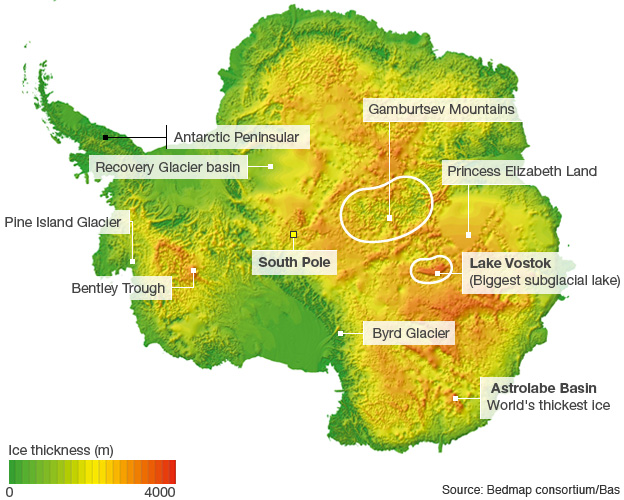
Antarctica-ice-thickness-2013

'Best estimate' for impact of melting ice on sea level rise Researchers say they now have the most accurate estimate yet for the impact of the melting of ice sheets. Researchers have published their most advanced calculation for the likely impact of melting ice on global sea levels. The EU funded team say the ice sheets and glaciers could add 36.8 centimetres to the oceans by 2100. Adding in other factors, sea levels could rise by up to 69 centimetres, higher than previous predictions. The researchers say there is a very small chance that the seas around Britain could rise by a meter. “The previous IPCC identified this gap in our knowledge, we've addressed that gap and what we've found is not scary” Prof Tony Payne, University of Bristol The last Intergovernmental Panel on Climate Change (IPCC) report was highly detailed about many aspects of Earth's changing climate in the coming decades, Advanced models While they estimated that sea levels could rise by 18-59 centimetres by 2100, they were very unsure about the role played by the melting of ice sheets and mountain glaciers. To fill the void, the EU funded experts from 24 institutions in Europe and beyond to try and come up with more accurate figures on the melting of ice sheets and glaciers in Antarctica and Greenland and how this might swell the oceans. Called Ice2sea, the group of scientists have made what they term the "best estimate" yet of the impact of melting based on a mid-range level of carbon emissions that would increase global temperatures by 3.5C by the end of this century.

Carbon dioxide level passes 400 ppm - global warming

Carbon dioxide passes symbolic mark - Noaa atmospheric lab - The measurements are made at a station on the Mauna Loa volcano The level of carbon dioxide in the atmosphere has risen above 400 parts per million for the first time in human history, US researchers say. The "Keeling Lab" in Hawaii has the longest continuous measurement of the greenhouse gas, which is a key driver of climate change. Thursday's measurement, made atop the Mauna Loa volcano, registered 400.03. The last time CO2 was regularly above 400ppm was about 3-5 million years ago - before modern humans existed. The climate back then was also considerably warmer than it is today, according to scientists. The usual trend seen at the volcano is for the CO2 concentration to rise in winter months and then to fall back as the northern hemisphere growing season kicks in and pulls some of the gas out of the atmosphere. This means the number can be expected to decline by a few ppm in the coming weeks. But the long-term trend is upwards. When the late Charles Keeling began recording CO2 concentrations at the volcano in 1958, they were around 315 ppm (parts per million by volume - that is 315 molecules of CO2 for every one million molecules in the air). Every year since then, the curve has squiggled resolutely higher.

Siberian permafrost thaw warning

Siberian permafrost thaw warning sparked by cave data

Siberian cave


The caves record changing conditions over hundreds of thousands of years


Evidence from Siberian caves suggests that a global temperature rise of 1.5C could see permafrost thaw over a large area of Siberia.

A study shows that more than a trillion tonnes of the greenhouse gases CO2 and methane could be released into the atmosphere as a result. An international team has published details in the journal Science. The evidence comes from analysis of stalactites and stalagmites in caves along the "permafrost frontier". This is where ground begins to be permanently frozen in layers that can be tens to hundreds of metres thick. Stalactites and stalagmites only grow when liquid rainwater and snowmelt drip into the caves. So these formations record 500,000 years of changing permafrost conditions - including warmer periods similar to the climate of today.

Cave


Thawing of permafrost would have huge implications for ecosystems, says the team

Reptiles are going extinct

World's reptiles at risk of extinction


A mountain horned agama lizard


Many lizards are under threat, including the mountain horned agama of Sri Lanka


Almost a fifth of the world's reptile species are at risk of extinction, according to scientists.

Research led by the Zoological Society of London found that the future of 19% of the world's reptiles are threatened. Conservation experts also confirmed that 47% are vulnerable and highlighted the possible extinction of three species. The figures are based on a random sample of 1,500 of the world's reptile species. "It's essentially an election poll set up - using this sample to give an example of how reptiles are doing as a whole," explained Dr Monika Bohm, lead author of the study published in the journal Biological Conservation. The study was made in conjunction with 200 experts from the International Union for the Conservation of Nature's Species Survival Commission.


Lava lizard basks on the head of a marine iguana

Soot has large role in climate change

Climate change: Soot's role underestimated


wood fire


The burning of wood is a major source of black carbon the world over.


Black carbon, or soot, is making a much larger contribution to global warming than previously recognised, according to research.

Scientists say that particles from diesel engines and wood burning could be having twice as much warming effect as assessed in past estimates. They say it ranks second only to carbon dioxide as the most important climate-warming agent. The research is in the Journal of Geophysical Research-Atmospheres. Black carbon aerosols have been known to warm the atmosphere for many years by absorbing sunlight. They also speed the melting of ice and snow. This new study concludes the dark particles are having a warming effect approximately two thirds that of carbon dioxide, and greater than methane.

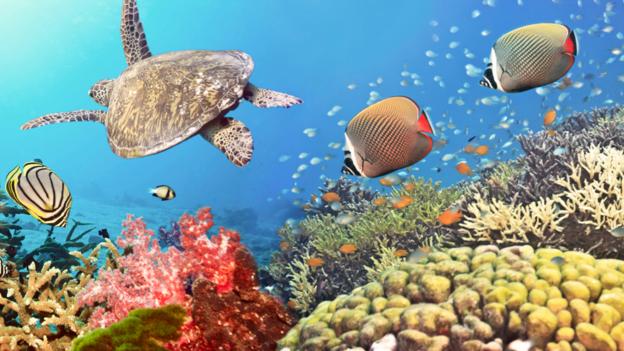
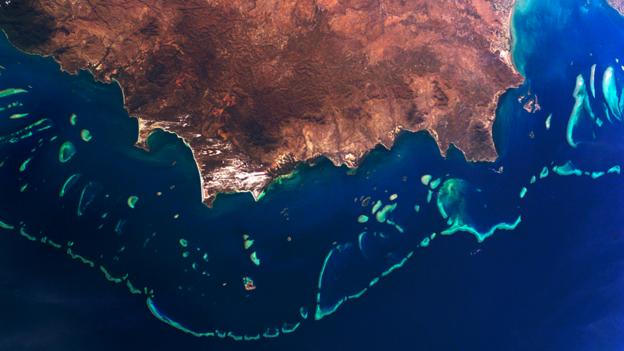
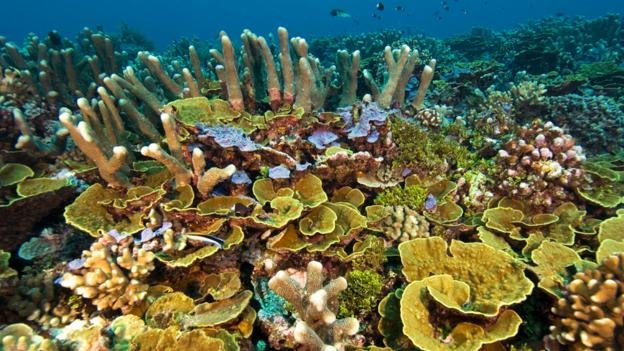
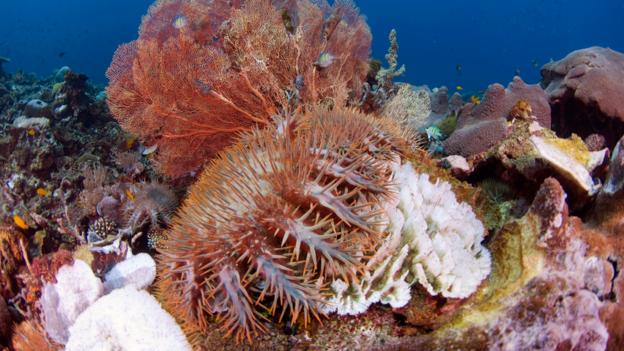
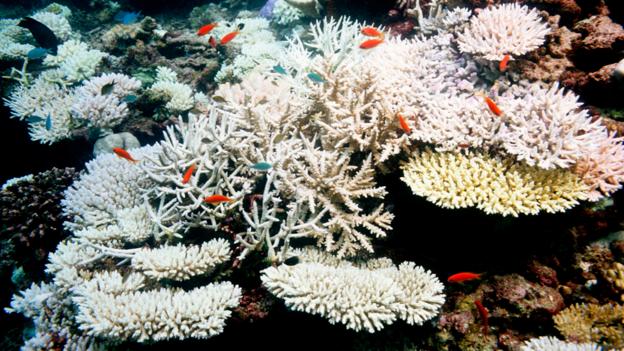
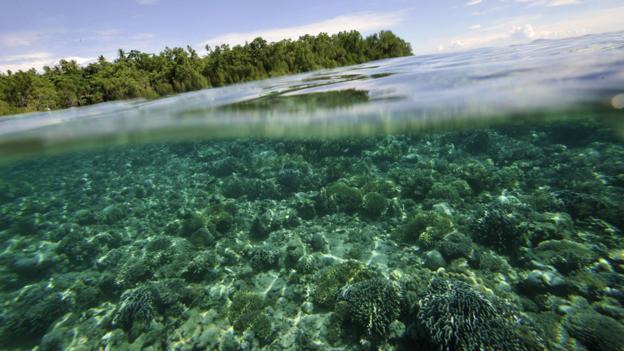
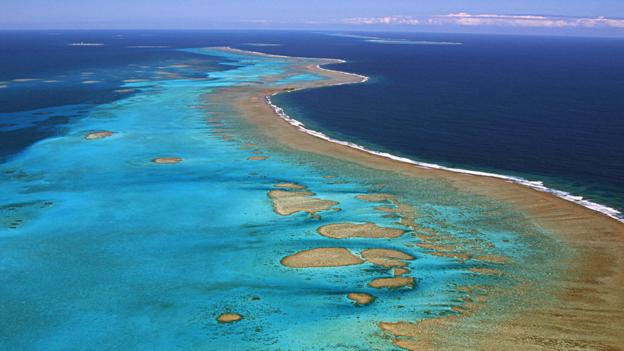
Endangered Coral Reefs in steep decline

Are we losing all of our coral reefs?


West Antarctic Ice Sheet warming - Antarctica

West Antarctic Ice Sheet warming twice earlier estimate


Byrd station data


The data from Byrd Station shows rapid warming on the west Antarctic ice sheet.

A new analysis of temperature records indicates that the

Greenhouse gases hit record high - 2011

Monitoring station in Hawaii
 
The WMO and Noaa operate monitoring stations around the world
 

Greenhouse gases in the atmosphere hit a new record high in 2011, the World Meteorological Organization has said.

Pages