Languages

Causes of Extinction

English

Tanzania Elephant illegal ivory bought by China officials 2014

illegal ivory china 2012

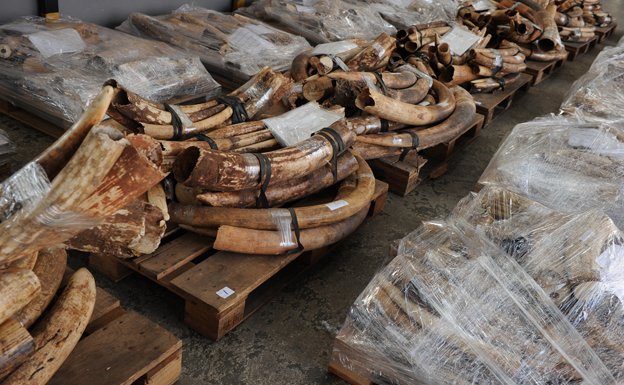
Ivory tusks seized during an anti-smuggling operation are displayed during a Hong Kong Customs press conference on October 20, 2012 Officials travelling to Tanzania with Chinese President Xi Jinping went on a buying spree for illegal ivory, an environmental activist group has said. The delegation bought so much ivory prices in the local market soared, the Environmental Investigation Agency (EIA) said in a report. Tanzania rejected the report as "stupid nonsense". China said the allegations were "groundless". Conservationists say demand for ivory in China is fuelling poaching. In recent years, poaching has increased across sub-Saharan Africa, with criminal gangs slaughtering elephants for ivory. Tanzania is the largest source of poached ivory in the world, according to the EIA. 'Security checks averted' The EIA report cited a trader in Tanzania's main port city, Dar es Salaam, named as Suleiman Mochiwa, who met undercover investigators. He said that when the Chinese government and business delegation arrived, ivory prices in the local market doubled to $700 (£438) per kilo during the visit. Earlier this year China destroyed a large quantity of confiscated ivory for the first time "The [delegation]... used the opportunity to procure such a large amount of ivory that local prices increased," the report says. Investigators alleged that the Chinese buyers could take advantage of a lack of security checks for those in the country on a diplomatic visit.

Chinese Yangtze river ancient sturgeon almost extinct in 2014

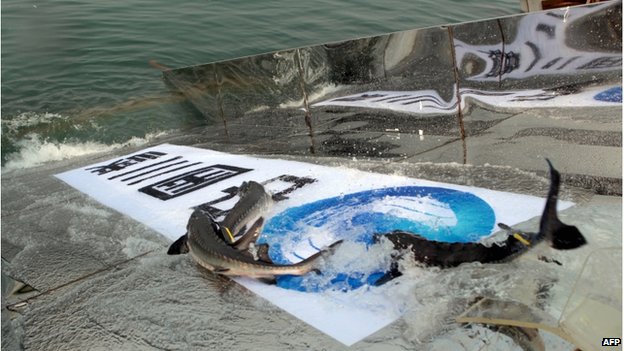
artifically-bred critically endangered almost extinct Yangtze river sturgeons being released into river; China
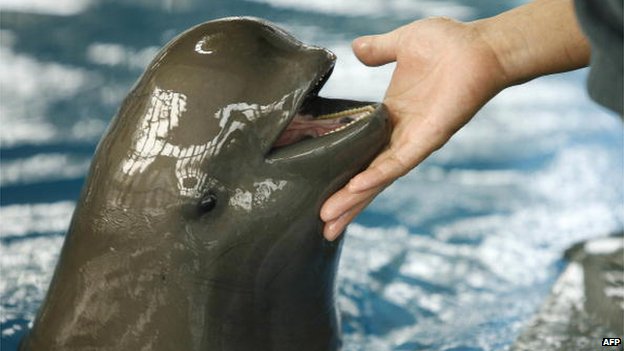
critically endangered finless porpoise yangtze river china

Ancient sturgeon in China's Yangtze 'nearly extinct' This picture taken on 13 April 2014 shows artificially bred Chinese sturgeons released into the Yangtze river in Yichang, central China's Hubei province The Chinese sturgeon, thought to have existed for more than 140 million years, is now on the brink of extinction, according to local media. Xinhua reported that no wild sturgeon reproduced naturally last year in the Yangtze river. It was the first time since researchers began recording levels 32 years ago. Chinese researches say the fall is due to rising levels of pollution in the Yangtze river and the construction of dozens of dams. Researchers from the Chinese Academy of Fishery Sciences also found that no young sturgeons were found swimming along the Yangtze toward the sea during the period they usually do so. A researcher told Xinhua that in the 1980s, at least several thousand sturgeon could be found in the river. It is estimated only around 100 fish remain. "Without natural reproduction, the fish population cannot replenish itself. If there are no further steps taken to strengthen conservation, the wild sturgeon faces the danger of extinction," he said. The finless porpoise, another native species to the Yangtze river, is said to be at risk as well. In recent decades the Chinese authorities have built numerous dams along the 6,300km-long Yangtze river to boost the country's electricity supply. Such moves have drawn criticism of environmental degradation and displacement of villagers.

Caribbean coral reefs becoming extinct

healthy-coral-bermuda_0.jpg Reef in Bermuda. Healthy coral reefs have declined by about 50% in the past 40 years Many of the Caribbean's coral reefs could vanish in the next 20 years, according to a report published by the International Union for the Conservation of Nature (IUCN). Data from more than 35,000 surveys suggests that habitats have declined by more than 50% since the 1970s. The report's authors believe that over-fishing and disease is mainly to blame. They say the trend could continue if nothing is done, but with protection the reefs could bounce back. Carl Gustaf Lundin, director of IUCN's Global Marine and Polar Programme, said the findings were alarming. "The reefs support a number of different countries and populations," he said. "Tourism is one of the biggest industries, and the health of the reef is essential to the well-being of many of the people living there. And of course they are immensely beautiful and wonderful places as well." coral-overgrown-with-algae-jamaica-2013_0.jpg Reef overrun with algae The reefs are becoming over-run with algae, which suffocates the coral. The report, which was also authored by the Global Coral Reef Monitoring Network, looked at data collected between 1970 and 2012 from 90 reef habitats and is the most comprehensive assessment of corals in this region.

Indonesia surpasses Brazil in deforestation rate

deforestation-indonesia-2013.jpg This photo taken on 13 November 2013 shows a timber company's vehicle driving down a dirt road in the forests of in Berau, East Kalimantan. Researcher say deforestation has led to an increase in greenhouse gas emissions and a loss of Indonesia's biodiversity. A new study has shown that Indonesia lost about 60,000 sq km of virgin forest - an area close to the size of Ireland - over a period of 12 years. The rate of deforestation has increased so much that Indonesia has for the first time surpassed Brazil in the rate of its clearance of tropical forests. The study was published in the journal Nature Climate Change. Scientists monitored the growth of deforested land in Indonesia between 2000 and 2012 using satellites. indonesia-sattelite-image-riau-deforestation.jpg Picture of Riau province's rate of deforestation. Satellite imagery of Indonesia's Riau province showed wetland forest loss (in red) and forest degradation (in blue) over the study period They say the land was cleared to make way for palm oil plantations and other farms. By 2012, the loss of primary forest every year in Indonesia was estimated to be higher than that in Brazil, said scientists. In that year, Indonesia lost 8,400 sq km of forest compared to Brazil which lost 4,600 sq km.

Africa Elephants endangered - survival threat due to poaching

African elephants endangered species illegal poaching ivory trade
illegal poaching ivory trade China killing endangered african elephant

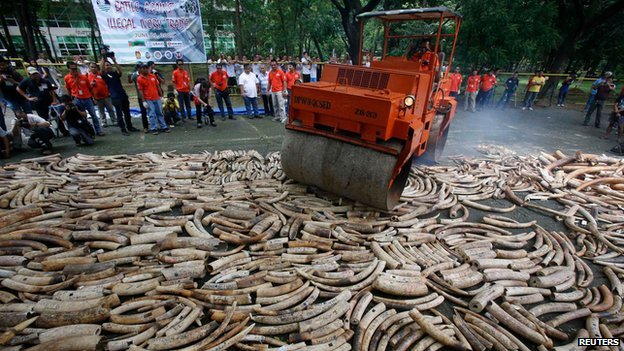
Africa elephants 'face survival threat' from poaching. Elephant conservationists say demand for ivory remains high. The survival of Africa's elephants is under threat, with estimates suggesting more than 20,000 were killed in 2013, a report says. The office of the Convention on International Trade in Endangered Species (Cites) said poaching levels were far above the elephant birth rate. However, the report said poaching numbers had dropped slightly compared to the previous two years. Transnational organised crime appeared to be involved in the trade, it added. Cites, which is based in Geneva, is responsible for regulating the international trade in more than 35,000 species of plants and animals. Ivory tusks and products are displayed after the official start of the destruction of confiscated ivory in Hong Kong 15 May 2014 China has started to destroy seized ivory in public There are a number of interesting signals in these latest figures, perhaps indicating that the tougher line being taken by Cites is bearing fruit. For the first time, more large-scale consignments of ivory have been seized in Africa rather than in Asia. This is down to better policing in Kenya, Tanzania and Uganda and perhaps a slight downturn in demand from the key markets such as China, which carried out the first public destruction of ivory earlier this year. There is also the rise in demand in China for legal mammoth ivory that is mainly exported from Russia, which may also indicate a growing awareness of the connection to elephants and a willingness to look at alternatives.

Organised crime and Asian superstition driving rhinos and elephants to extinction

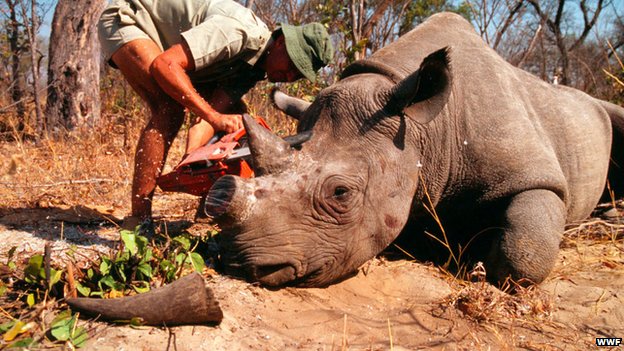
Ivory destruction Despite efforts to destroy ivory, criminals are becoming more organised, ingenious and dangerous. "We have seen more and more organised crime networks moving into the wildlife trade," says Davyth Stewart from Interpol, the international intelligence agency. "Groups who have been traditionally involved in drug trafficking, fire arms and human trafficking are now moving onto wildlife." It's clearly not a fair match: conservationists pitted against criminal gangs. But the wildlife experts say it's a fight they have to take on. They have gathered at the Zoological Society of London to tackle how to halt the rapidly growing trade in animals. The backdrop to these crisis talks is bleak. Thousands of rhinos, elephants, tigers and others have been slaughtered, becoming part of an illegal market that's worth an estimated $19bn a year. Many criminals see it as low risk, high profit, says Mr Stewart. "There is a lower risk of apprehension, it's unfortunate but law enforcement has not invested the resources in attacking wildlife crime as it has in other crimes," he explains. "Even in courts the penalties are much lower. Just last year in Ireland, we saw two people arrested for smuggling rhino horns worth half a million euros. They received a 500-euro fine." Demand and supply John Sellar, the former chief of enforcement at Cites (the Convention on International Trade in Endangered Species), says the focus of the battle should be shifted away from conservation towards the issue of criminality. "It's about locking up the bad guys," he tells the conference.

Killer starfish threaten Great Barrier Reef

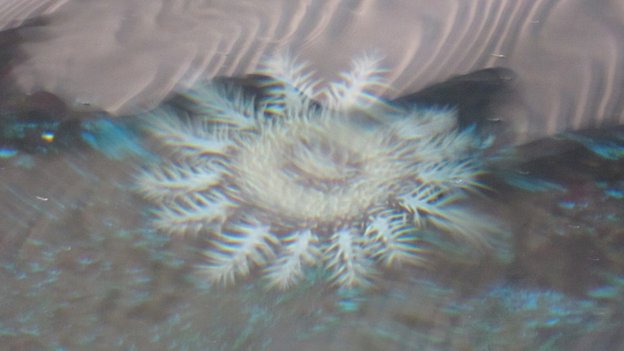
Killer starfish threaten Great Barrier Reef Crown-of-thorns starfish have a voracious appetite and waves of carnivorous starfish are eating their way through Australia's Great Barrier Reef - and sugar cane farming is being blamed. Researchers at Australia's Institute of Marine Science (AIMS), just outside Townsville, Queensland, in north-east Australia, have mapped the pattern of destruction. "Coral cover is half of what it was 27 years ago, coral cover is going down at an alarming rate." Dr Katharina Fabricius, coral reef ecologist and AIMS principal research scientist, told the BBC World Service programme Discovery. She said the biggest culprit was the Crown of Thorns Starfish (COTs). "There are three main sources for the coral decline, one is storms, however 42% is attributed to Crown of Thorns Starfish - and just 10% due to bleaching. This compares with 70% due to bleaching for reefs elsewhere in the world , such as in the Caribbean." “Crown of Thorns are very fecund animals - each female can produce between five and 20 million eggs ” John Brodie, James Cook University Bleaching occurs when corals are stressed by changes in conditions such as temperature, light, or nutrients. They expel the symbiotic algae living in their tissues, causing them to turn completely white. Australian scientists are now looking at ways to reduce the destruction wreaked by starfish, which have the ability to smother coral and digest the fleshy parts.

Amazon and Global Deforestation rose in 2013

Brazil says Amazon deforestation rose 28% in a year

Brazil Environment minister Izabella Teixeira
Minister Izabella Teixeira says she will tackle the problem with local authorities.

Brazil says the rate of deforestation in the Amazon increased by 28% between August 2012 and last July, after years of decline. The government is working to reverse this "crime", Environment Minister Izabella Teixeira said. Activists have blamed the increase in destruction on a controversial reform to Brazil's forest protection law. Last year Brazil reported the lowest rate of deforestation in the Amazon since monitoring began. The provisional statistics from August 2012 to last July suggest that the area suffering deforestation was 5,843 sq km (2,255 sq miles), compared to 4,571 sq km (1,765 sq miles) in the previous 12 months. The 28% rise interrupts a period of declining deforestation which began in 2009. However, it still remains the second lowest annual figure for forest loss in absolute terms. The worst year on record was 2004, when 27,000 sq km of forest was destroyed. Monthly data from several scientific institutions had suggested the deforestation rate might be on the rise.

Ocean Acidification caused by CO2 Emissions

Emissions of CO2 driving rapid oceanic acidification


Great barrier reef
Corals all over the world are threatened by rising rates of acidification in the oceans.
 

The world's oceans are becoming acidic at an "unprecedented rate", more rapidly than at any time in the past 300 million years. In their strongest statement yet on this issue, scientists say acidification could increase by 170% by 2100. They say that some 30% of ocean species are unlikely to survive in these conditions. The researchers conclude that human emissions of CO2 are clearly to blame. The study will be presented at global climate talks in Poland next week.

In 2012, over 500 of the world's leading experts on ocean acidification gathered in California. Led by the International Biosphere-Geosphere Programme, a review of the state of the science has now been published. This Summary for Policymakers states with "very high confidence" that increasing acidification is caused by human activities which are adding 24 million tonnes of CO2 to oceans every day.

Fossil fuel subsidies a reckless use of public funds

The world is spending half a trillion dollars on fossil fuel subsidies every year, according to a new report. The Overseas Development Institute (ODI) says rich countries are spending seven times more supporting coal, oil and gas than they are on helping poorer nations fight climate change. Fuel subsidies to US farmers amounted to $1bn in 2011 says the ODI. Some countries including Egypt, Morocco and Pakistan, have subsidies bigger than the national fiscal deficit. The new report calls on the G20 to phase out the payments by 2020. While there is no globally agreed definition of what a fossil fuel subsidy actually is, the report draws on a range of sources from the International Monetary Fund to the International Energy Agency. It details the range of financial help given to oil, coal and gas producers and consumers from national governments and through international development. What emerges is a complicated web of different types of payments in different countries. In the United States, for example, the government in 2011 gave a $1bn fuel tax exemption to farmers, $1bn for the strategic petroleum reserve and $0.5bn for oil, coal and gas research and development. Germany gave financial assistance totalling 1.9bn euro to the hard coal sector in the same year. And the UK gave tax concessions worth £280m in 2011 for oil and gas production. Pakistan is a country with the second highest number of children out of school in the world. It has some of the worst nutrition, maternal mortality and child health indicators.

Pages