Languages

Tropical Forest Habitat

English

The illegal ivory trade threatening African Elephants

The illegal ivory trade threatening Africa's elephants


Nairobi's elephant orphanage cares for babies of mothers killed by poachers.

Despite a 23-year ban on international trade in ivory, elephants continue to be shot for their prized tusks, with much of the material ending up on sale in China. The very future of the African elephant, the largest land animal on Earth, could be at risk. Last year saw the highest number of large seizures of illegal ivory for more than two decades. From Kenya to Zambia, African law-enforcement and conservation authorities are facing a continuing battle with the poachers. And it is in the Democratic Republic of Congo, where governance is at its weakest, that the elephant population is being hit hardest, with thousands of elephants killed each year. Conservationists have recorded steep declines in population and fear fewer than 20,000 of the region's forest elephants remain in the Congo basin.  

Tropical Forest Habitat

Tropical forests Tropical forests, also known as rainforests, are found between the equator and the two tropics (Tropic of Cancer and Tropic of Capricorn).
The temperature of these forests ranges from 20°C to 34°C. These regions receive heavy rainfall throughout the year; the annual rainfall is more than 200 cm. The variety of flora and fauna found in these forests is vast (Fig. 10.1).
Plants: Orchid, vine, moss, and fern.
Animals: Bat, gorilla, monkey, jaguar, sloth, macaw, toucan, and a variety of insects.

Preserving the genetic diversity of ancient trees

Even as we discover the incredible benefits of the world's most ancient trees, we are losing them to climate change.

In 2005, several of the centuries-old ponderosa pine trees on my 15 acres (0.06 sq km) of forest in the northern Rocky Mountains in Montana suddenly died. I soon discovered they were being brought down by mountain pine beetles, pernicious killers the size of the eraser on a pencil that burrow into the tree.

The next year the number of dying trees grew exponentially. I felt powerless and grief-stricken as I saw these giant, sky-scraping trees fading all around me, realising there was nothing I could do to stop it.

While the native bugs were the proximate cause, the underlying reason for the unprecedented mortality in my home state and throughout the Rockies was that winters had stopped getting really cold. When I first moved to Montana in the late 1970s, temperatures of -34C (-30F) or even below -40C (-40F) were common in winter, sometimes for weeks at a time. The coldest temperature on record in Montana is –57C (-70F). These days wintertime minimum temperatures rarely get below -18C (0F) or so. If they do, it is usually just for a day or two. That's not nearly cold enough to kill pine beetles, which make their own natural antifreeze.

Horrible extinction risk to plants - May 2016

Scientists have published their first global assessment of the state of the world's plants.

They warn that 21% of all plants are at risk of extinction and face a broad range of threats. The research was carried out by the Royal Botanic Gardens Kew in the UK.   See the full report:   here

Populations of some of the world's largest wild animals are dwindling, raising the threat of an "empty landscape", say scientists.


About 60% of giant herbivores - plant-eaters - including rhinos, elephants and gorillas, are at risk of extinction, according to research.

Analysis of 74 herbivore species, published in Science Advances, blamed poaching and habitat loss.

A previous study of large carnivores showed similar declines.

Prof William Ripple, of Oregon State University, led the research looking at herbivores weighing over 100kg, from the reindeer up to the African elephant.

"This is the first time anyone has analysed all of these species as a whole," he said.

"The process of declining animals is causing an empty landscape in the forest, savannah, grasslands and desert."
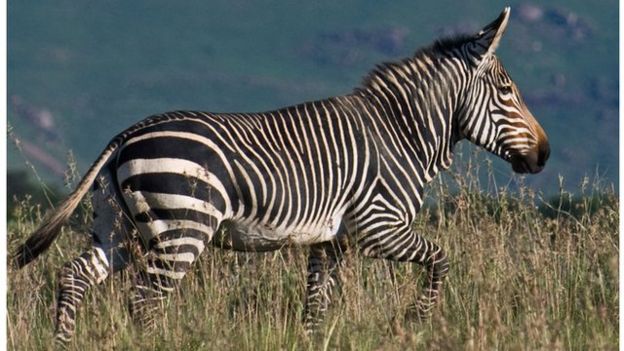
The threatened mountain zebra

The threatened mountain zebra

Prof David Macdonald, of Oxford University's Wildlife Conservation Research Unit, was among the team of 15 international scientists.

"The big carnivores, like the charismatic big cats or wolves, face horrendous problems from direct persecution, over-hunting and habitat loss, but our new study adds another nail to their coffin - the empty larder," he said.

"It's no use having habitat if there's nothing left to eat in it."

According to the research, the decline is being driven by a number of factors including habitat loss, hunting for meat or body parts, and competition for food and resources with livestock.

Rubber plantations destroying biodiversity and forcing habitat loss for endangered birds, bats and primates in Southeast Asia

The global demand for rubber tyres is threatening protected forests in Southeast Asia, according to a study. Tropical forests are being cleared for rubber plantations, putting endangered birds, bats and primates at risk, say UK researchers. By 2024, up to 8.5 million hectares of new rubber plantations will be needed to meet demand, they report in Conservation Letters. This could have a "catastrophic" impact on wildlife, they warn. Species such as the endangered white-shouldered ibis, yellow-cheeked crested gibbon and clouded leopard could lose precious habitat, said the team led by Eleanor Warren-Thomas, from the School of Environmental Sciences at the University of East Anglia. Also, the banteng, which is found in the forests of Cambodia. There's a lot we can do as scientists and the public to make rubber production more wildlife-friendly. "The tyre industry consumes 70% of all natural rubber grown, and rising demand for vehicle and aeroplane tyres is behind the recent expansion of plantations. But the impact of this is a loss of tropical biodiversity," she said. "We predict that between 4.3 and 8.5 million hectares of new plantations will be required to meet projected demand by 2024. This will threaten significant areas of Asian forest, including many protected areas." Eight-point-five million hectares is about the size of the land area of Austria. Biodiversity concern Rubber is the most rapidly expanding tree crop within mainland Southeast Asia.

Vietnamese rhino horn traffickers charged in South Africa

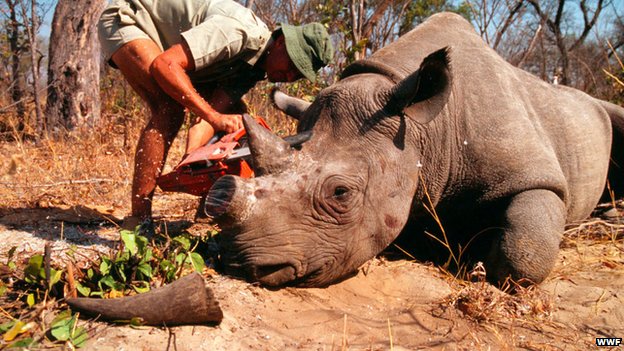
Two Vietnamese nationals in South Africa have been charged with the illegal possession of 41kg (90lbs) of rhino horn, police have told the BBC. Officials say it is the largest amount of black market rhino horn to be seized in South Africa. The men, believed to be linked to an international poaching ring, had been under surveillance before their arrest at a Johannesburg airport, police say. Nearly 900 rhino have been killed in South Africa since January. Rhino horn can sell for up to $65,000 (£47,500) per kg - which is nearly double the price of gold - with China and Vietnam being the largest markets. Police say the illegal haul was found by a dog that specialises in sniffing out rhino horn at OR Tambo International Airport in Johannesburg on Sunday. 'National crisis' Paul Ramaloko, spokesperson for South Africa's organised crime fighting unit, told the BBC it was equivalent of 20 rhino horns with an estimated value of $358,000. Some South Africans have staged protests calling for more action against poaching. "Rhino poaching is regarded as a national crisis - for this reason those found guilty of the crime are dealt with harshly," he said. It is believed that the horns were most likely to have been removed from animals in South Africa's Kruger National Park, but tests need to be done to determine their origin, officials say.

Indonesia surpasses Brazil in deforestation rate

deforestation-indonesia-2013.jpg This photo taken on 13 November 2013 shows a timber company's vehicle driving down a dirt road in the forests of in Berau, East Kalimantan. Researcher say deforestation has led to an increase in greenhouse gas emissions and a loss of Indonesia's biodiversity. A new study has shown that Indonesia lost about 60,000 sq km of virgin forest - an area close to the size of Ireland - over a period of 12 years. The rate of deforestation has increased so much that Indonesia has for the first time surpassed Brazil in the rate of its clearance of tropical forests. The study was published in the journal Nature Climate Change. Scientists monitored the growth of deforested land in Indonesia between 2000 and 2012 using satellites. indonesia-sattelite-image-riau-deforestation.jpg Picture of Riau province's rate of deforestation. Satellite imagery of Indonesia's Riau province showed wetland forest loss (in red) and forest degradation (in blue) over the study period They say the land was cleared to make way for palm oil plantations and other farms. By 2012, the loss of primary forest every year in Indonesia was estimated to be higher than that in Brazil, said scientists. In that year, Indonesia lost 8,400 sq km of forest compared to Brazil which lost 4,600 sq km.

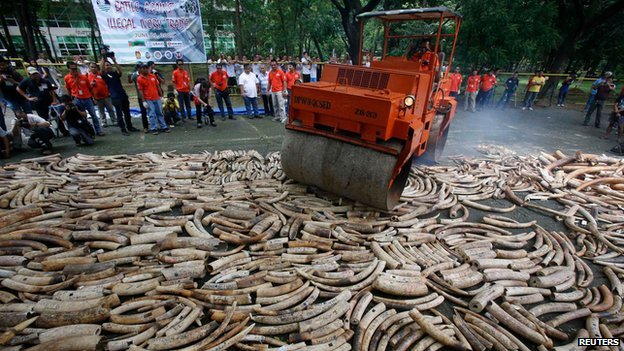
Africa Elephants endangered - survival threat due to poaching

African elephants endangered species illegal poaching ivory trade
illegal poaching ivory trade China killing endangered african elephant

Africa elephants 'face survival threat' from poaching. Elephant conservationists say demand for ivory remains high. The survival of Africa's elephants is under threat, with estimates suggesting more than 20,000 were killed in 2013, a report says. The office of the Convention on International Trade in Endangered Species (Cites) said poaching levels were far above the elephant birth rate. However, the report said poaching numbers had dropped slightly compared to the previous two years. Transnational organised crime appeared to be involved in the trade, it added. Cites, which is based in Geneva, is responsible for regulating the international trade in more than 35,000 species of plants and animals. Ivory tusks and products are displayed after the official start of the destruction of confiscated ivory in Hong Kong 15 May 2014 China has started to destroy seized ivory in public There are a number of interesting signals in these latest figures, perhaps indicating that the tougher line being taken by Cites is bearing fruit. For the first time, more large-scale consignments of ivory have been seized in Africa rather than in Asia. This is down to better policing in Kenya, Tanzania and Uganda and perhaps a slight downturn in demand from the key markets such as China, which carried out the first public destruction of ivory earlier this year. There is also the rise in demand in China for legal mammoth ivory that is mainly exported from Russia, which may also indicate a growing awareness of the connection to elephants and a willingness to look at alternatives.

Organised crime and Asian superstition driving rhinos and elephants to extinction

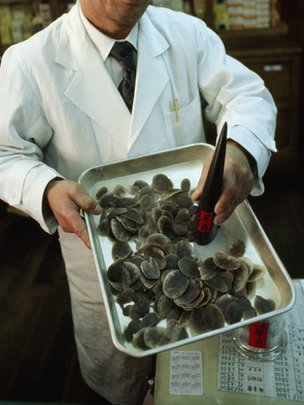
Ivory destruction Despite efforts to destroy ivory, criminals are becoming more organised, ingenious and dangerous. "We have seen more and more organised crime networks moving into the wildlife trade," says Davyth Stewart from Interpol, the international intelligence agency. "Groups who have been traditionally involved in drug trafficking, fire arms and human trafficking are now moving onto wildlife." It's clearly not a fair match: conservationists pitted against criminal gangs. But the wildlife experts say it's a fight they have to take on. They have gathered at the Zoological Society of London to tackle how to halt the rapidly growing trade in animals. The backdrop to these crisis talks is bleak. Thousands of rhinos, elephants, tigers and others have been slaughtered, becoming part of an illegal market that's worth an estimated $19bn a year. Many criminals see it as low risk, high profit, says Mr Stewart. "There is a lower risk of apprehension, it's unfortunate but law enforcement has not invested the resources in attacking wildlife crime as it has in other crimes," he explains. "Even in courts the penalties are much lower. Just last year in Ireland, we saw two people arrested for smuggling rhino horns worth half a million euros. They received a 500-euro fine." Demand and supply John Sellar, the former chief of enforcement at Cites (the Convention on International Trade in Endangered Species), says the focus of the battle should be shifted away from conservation towards the issue of criminality. "It's about locking up the bad guys," he tells the conference.

Pages

Email Addresses