Languages

Solutions to Extinction of Species

English

Solutions

Solutions to Exinction of Species are many and include making and enforcing laws protecting species and their habitats, ending the use of fossil fuesl, reducing and eliminating Pollution, Pesticides, Overpopulation, Population Growth, Development, etc.

Preserving the genetic diversity of ancient trees

Even as we discover the incredible benefits of the world's most ancient trees, we are losing them to climate change.

In 2005, several of the centuries-old ponderosa pine trees on my 15 acres (0.06 sq km) of forest in the northern Rocky Mountains in Montana suddenly died. I soon discovered they were being brought down by mountain pine beetles, pernicious killers the size of the eraser on a pencil that burrow into the tree.

The next year the number of dying trees grew exponentially. I felt powerless and grief-stricken as I saw these giant, sky-scraping trees fading all around me, realising there was nothing I could do to stop it.

While the native bugs were the proximate cause, the underlying reason for the unprecedented mortality in my home state and throughout the Rockies was that winters had stopped getting really cold. When I first moved to Montana in the late 1970s, temperatures of -34C (-30F) or even below -40C (-40F) were common in winter, sometimes for weeks at a time. The coldest temperature on record in Montana is –57C (-70F). These days wintertime minimum temperatures rarely get below -18C (0F) or so. If they do, it is usually just for a day or two. That's not nearly cold enough to kill pine beetles, which make their own natural antifreeze.

Toxic 'forever chemicals' found in British otters

Toxic "forever chemicals" used in non-stick saucepans and food packaging have been found in otters across England and Wales, according to a study.

The substances, called PFASs, are also used in waterproof clothing, stain resistant products and fire retardants.

The chemicals are linked to pregnancy complications, liver disease, cancer and other illnesses.

Scientists say concentrations of these compounds in otters are a guide to levels of pollution in the environment.

The substances can leach out from products, getting into drains and sewage treatment works - from which they can then escape and contaminate the environment more widely.

PFAS substances are present in farmland sludge, which can wash from fields into rivers. Factories and landfill sites are another source for the chemicals.

Denmark recently banned their use in food packaging paper.

Used since the late 1940s, PFAS chemicals - which are divided into compounds called perfluoroalkyls and polyfluoroalkyls - help to make products water, grease and stain resistant.

They are known as "forever chemicals" because they don't break down easily in the environment. They contaminate fish, which can then be ingested by animals and humans. PFAS compounds can also get directly into drinking water.

CITES bans lead to subsequent improvements in mammalian species’ IUCN status, relative to species in which trade was not banned

The Convention on International Trade in Endangered Species (CITES) bans international trade in species threatened with extinction. We investigate the effects of these bans on species’ endangerment, as assessed by the International Union for Conservation of Nature (IUCN). Our analysis exploits changes in CITES bans between 1979 and 2017. We find that CITES bans lead to subsequent improvements in mammalian species’ IUCN status, relative to species in which trade was not banned. These effects are primarily due to improvements in the status of commercially targeted species. On the other hand, CITES bans lead to deteriorations in reptilian species’ IUCN status. We find that major spikes in trade volume occurred in anticipation of the bans on reptilian species but not in anticipation of those on mammalian species.


World's wilderness reduced by a tenth since 1990s - 2015

wilderness lost from 1993 to 2015 worldwide

A tenth of the world's wilderness has vanished in the past two decades, research shows. New maps show "alarming losses" of pristine landscapes, particularly in South America and Africa, according to World Conservation Society scientists. They argue in Current Biology that wild areas are ignored in international conservation agreements, despite their ecological and cultural value.

About 20% of the world's land area is classed as wilderness. By this, scientists mean landscapes free of large-scale human disturbances such as housing, development and industry. The majority of these untouched spaces are found in North America, north Asia, north Africa and Australia. They are often home to indigenous peoples as well as endangered plants and animals.

James Watson of the University of Queensland, Australia, and the US Wildlife Conservation Society in New York said wilderness areas "are completely ignored in environmental policy". "International policy mechanisms must recognise the actions needed to maintain wilderness areas before it is too late," said Prof Watson. "We probably have one to two decades to turn this around."

Climate Engineering Danger - Not a solution.

Any attempts to engineer the climate are likely to result in "different" climate change, rather than its elimination, new results suggest.

Prof Ken Caldeira, of Stanford University, presented research at a major conference on the climate risks and impacts of geoengineering.

These techniques have been hailed by some as a quick fix for climate change.

But the impacts of geoengineering on oceans, the water cycle and land environments are hotly debated.

They have been discussed at a meeting this week of 12,000 scientists in Vienna.

Researchers are familiar with the global cooling effects of volcanic eruptions, seen both historically and even back into the deep past of the rock record.

With this in mind, some here at the European Geosciences Union General Assembly have been discussing the possible worldwide consequences of pumping sulphate aerosols into the stratosphere to attempt to reflect sunlight back into space and cool the planet.

Vietnamese rhino horn traffickers charged in South Africa

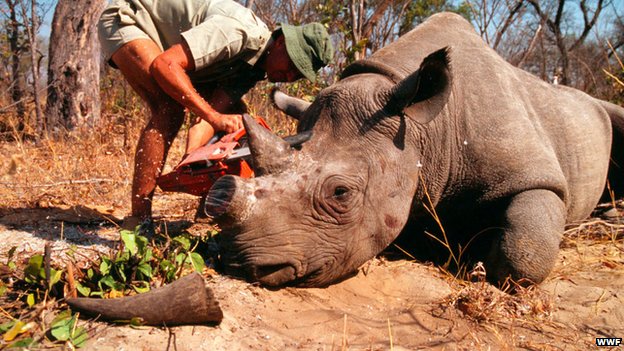
Two Vietnamese nationals in South Africa have been charged with the illegal possession of 41kg (90lbs) of rhino horn, police have told the BBC. Officials say it is the largest amount of black market rhino horn to be seized in South Africa. The men, believed to be linked to an international poaching ring, had been under surveillance before their arrest at a Johannesburg airport, police say. Nearly 900 rhino have been killed in South Africa since January. Rhino horn can sell for up to $65,000 (£47,500) per kg - which is nearly double the price of gold - with China and Vietnam being the largest markets. Police say the illegal haul was found by a dog that specialises in sniffing out rhino horn at OR Tambo International Airport in Johannesburg on Sunday. 'National crisis' Paul Ramaloko, spokesperson for South Africa's organised crime fighting unit, told the BBC it was equivalent of 20 rhino horns with an estimated value of $358,000. Some South Africans have staged protests calling for more action against poaching. "Rhino poaching is regarded as a national crisis - for this reason those found guilty of the crime are dealt with harshly," he said. It is believed that the horns were most likely to have been removed from animals in South Africa's Kruger National Park, but tests need to be done to determine their origin, officials say.

Tanzania Elephant illegal ivory bought by China officials 2014

illegal ivory china 2012

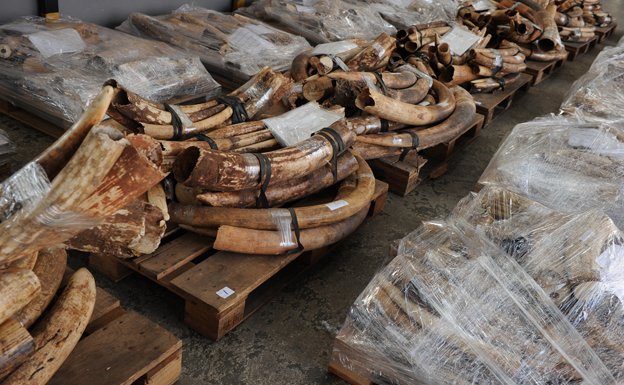
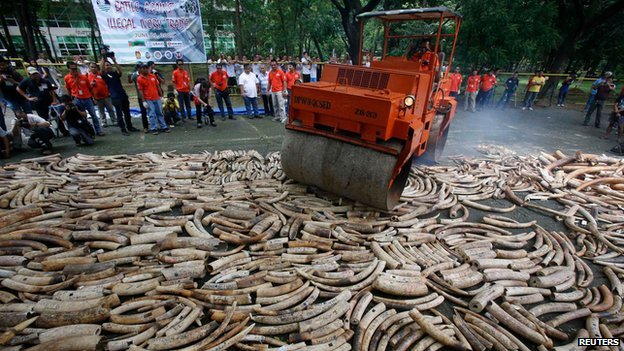
Ivory tusks seized during an anti-smuggling operation are displayed during a Hong Kong Customs press conference on October 20, 2012 Officials travelling to Tanzania with Chinese President Xi Jinping went on a buying spree for illegal ivory, an environmental activist group has said. The delegation bought so much ivory prices in the local market soared, the Environmental Investigation Agency (EIA) said in a report. Tanzania rejected the report as "stupid nonsense". China said the allegations were "groundless". Conservationists say demand for ivory in China is fuelling poaching. In recent years, poaching has increased across sub-Saharan Africa, with criminal gangs slaughtering elephants for ivory. Tanzania is the largest source of poached ivory in the world, according to the EIA. 'Security checks averted' The EIA report cited a trader in Tanzania's main port city, Dar es Salaam, named as Suleiman Mochiwa, who met undercover investigators. He said that when the Chinese government and business delegation arrived, ivory prices in the local market doubled to $700 (£438) per kilo during the visit. Earlier this year China destroyed a large quantity of confiscated ivory for the first time "The [delegation]... used the opportunity to procure such a large amount of ivory that local prices increased," the report says. Investigators alleged that the Chinese buyers could take advantage of a lack of security checks for those in the country on a diplomatic visit.

Organised crime and Asian superstition driving rhinos and elephants to extinction

Ivory destruction Despite efforts to destroy ivory, criminals are becoming more organised, ingenious and dangerous. "We have seen more and more organised crime networks moving into the wildlife trade," says Davyth Stewart from Interpol, the international intelligence agency. "Groups who have been traditionally involved in drug trafficking, fire arms and human trafficking are now moving onto wildlife." It's clearly not a fair match: conservationists pitted against criminal gangs. But the wildlife experts say it's a fight they have to take on. They have gathered at the Zoological Society of London to tackle how to halt the rapidly growing trade in animals. The backdrop to these crisis talks is bleak. Thousands of rhinos, elephants, tigers and others have been slaughtered, becoming part of an illegal market that's worth an estimated $19bn a year. Many criminals see it as low risk, high profit, says Mr Stewart. "There is a lower risk of apprehension, it's unfortunate but law enforcement has not invested the resources in attacking wildlife crime as it has in other crimes," he explains. "Even in courts the penalties are much lower. Just last year in Ireland, we saw two people arrested for smuggling rhino horns worth half a million euros. They received a 500-euro fine." Demand and supply John Sellar, the former chief of enforcement at Cites (the Convention on International Trade in Endangered Species), says the focus of the battle should be shifted away from conservation towards the issue of criminality. "It's about locking up the bad guys," he tells the conference.

Oceans health declining quickly

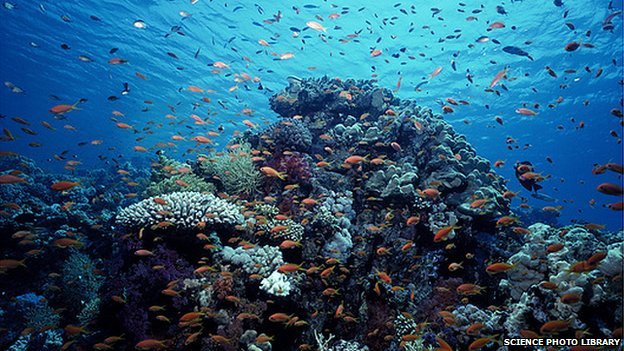
Corals are likely to suffer as a result of the changes to our oceans The health of the world’s oceans is deteriorating even faster than had previously been thought, a report says. A review from the International Programme on the State of the Ocean (IPSO), warns that the oceans are facing multiple threats. They are being heated by climate change, turned slowly less alkaline by absorbing CO2, and suffering from overfishing and pollution. The report warns that dead zones formed by fertiliser run-off are a problem. It says conditions are ripe for the sort of mass extinction event that has afflicted the oceans in the past. It says: “We have been taking the ocean for granted. It has been shielding us from the worst effects of accelerating climate change by absorbing excess CO2 from the atmosphere. “Whilst terrestrial temperature increases may be experiencing a pause, the ocean continues to warm regardless. For the most part, however, the public and policymakers are failing to recognise - or choosing to ignore - the severity of the situation.” It says the cocktail of threats facing the ocean is more powerful than the individual problems themselves. Coral reefs, for instance, are suffering from the higher temperatures and the effects of acidification whilst also being weakened by bad fishing practices, pollution, siltation and toxic algal blooms. IPSO, funded by charitable foundations, is publishing a set of five papers based on workshops in 2011 and 2012 in partnership with the International Union for Conservation of Nature (IUCN’s) World Commission on Protected Areas.

Pages