Languages

illegal poaching

English

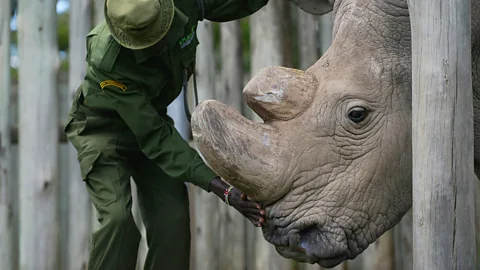
Last male of his kind: The rhino that became a conservation icon


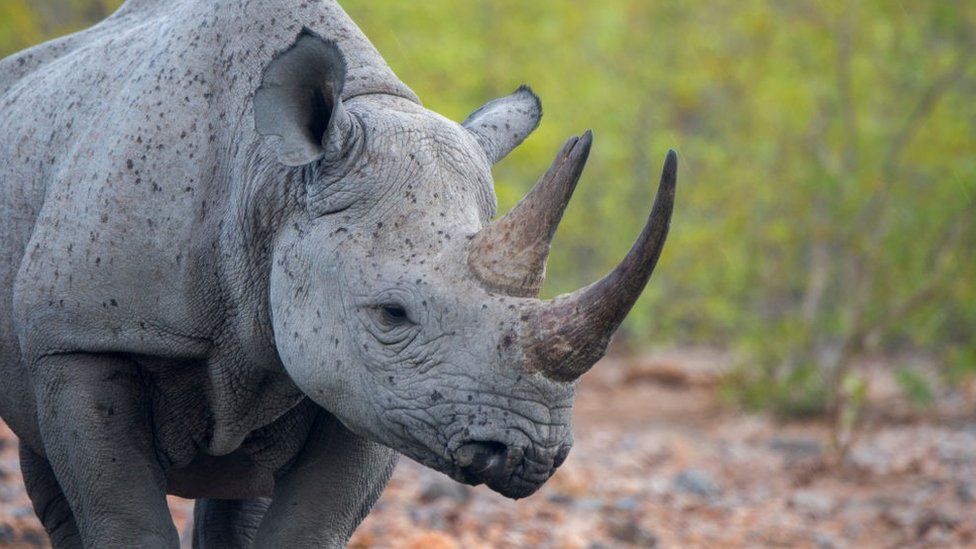
Getty Images The last male northern white rhino Sudan at the Ol Pejeta conservancy Kenya (Getty Images)

Tony Karumba's photo of Sudan with his carer made the rhino a global sensation in his final year

Sudan, the world's last male northern white rhino, died in 2018. In his final years, he became a global celebrity and conservation icon, helping raise awareness about the brutality of poaching.

Namibia reports record level of rhino poaching - 2022

Namibia reports record level of rhino poaching

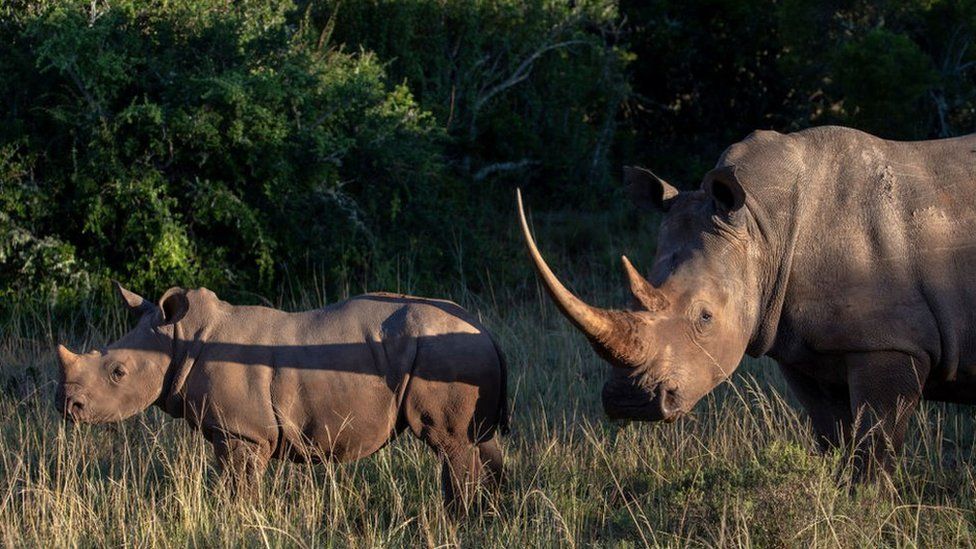
Close-up of a female white rhino in Namibia

A female white rhino in Namibia


The number of endangered rhinos poached in Namibia last year was the highest on record and almost twice as many as the year before, officials say.

A total of 87 rhinos were killed compared with 45 in 2021, official government data show.

Most were poached in Etosha, Namibia's biggest national park, officials say.

Rhino numbers in Africa have dropped significantly in recent decades to feed demand for rhino horn in China and Vietnam.

Kenya: Wildlife trafficking suspect seized after $1m reward

A crash, or group, of white rhinoceroses, also known as the square-lipped rhinoceros, is seen during a safari drive at the Shamwari Private Game Reserve on February 7, 2022 near the town of Paterson in South Africa's Eastern Cape province.

Mr Ahmed is suspected of trying to traffic rhinoceros horn and ivory


Kenyan police have arrested a man suspected of links to a transnational wildlife and drug trafficking syndicate who was indicted in a US court.

Abdi Hussein Ahmed, alias Abu Khadi, was detained on Tuesday in the central county of Meru after a tip-off from the public, police say.

The illegal ivory trade threatening African Elephants

The illegal ivory trade threatening Africa's elephants


Nairobi's elephant orphanage cares for babies of mothers killed by poachers.

Despite a 23-year ban on international trade in ivory, elephants continue to be shot for their prized tusks, with much of the material ending up on sale in China. The very future of the African elephant, the largest land animal on Earth, could be at risk. Last year saw the highest number of large seizures of illegal ivory for more than two decades. From Kenya to Zambia, African law-enforcement and conservation authorities are facing a continuing battle with the poachers. And it is in the Democratic Republic of Congo, where governance is at its weakest, that the elephant population is being hit hardest, with thousands of elephants killed each year. Conservationists have recorded steep declines in population and fear fewer than 20,000 of the region's forest elephants remain in the Congo basin.  

Organised crime and Asian superstition driving rhinos and elephants to extinction

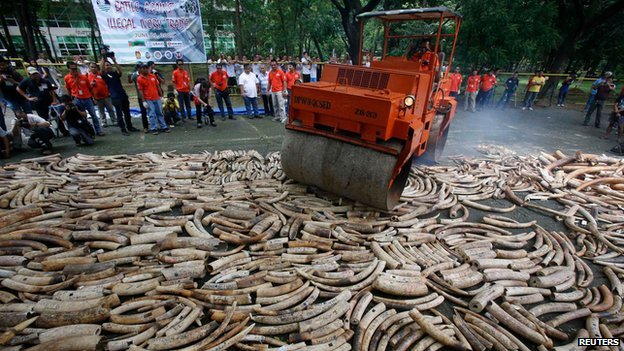
Ivory destruction Despite efforts to destroy ivory, criminals are becoming more organised, ingenious and dangerous. "We have seen more and more organised crime networks moving into the wildlife trade," says Davyth Stewart from Interpol, the international intelligence agency. "Groups who have been traditionally involved in drug trafficking, fire arms and human trafficking are now moving onto wildlife." It's clearly not a fair match: conservationists pitted against criminal gangs. But the wildlife experts say it's a fight they have to take on. They have gathered at the Zoological Society of London to tackle how to halt the rapidly growing trade in animals. The backdrop to these crisis talks is bleak. Thousands of rhinos, elephants, tigers and others have been slaughtered, becoming part of an illegal market that's worth an estimated $19bn a year. Many criminals see it as low risk, high profit, says Mr Stewart. "There is a lower risk of apprehension, it's unfortunate but law enforcement has not invested the resources in attacking wildlife crime as it has in other crimes," he explains. "Even in courts the penalties are much lower. Just last year in Ireland, we saw two people arrested for smuggling rhino horns worth half a million euros. They received a 500-euro fine." Demand and supply John Sellar, the former chief of enforcement at Cites (the Convention on International Trade in Endangered Species), says the focus of the battle should be shifted away from conservation towards the issue of criminality. "It's about locking up the bad guys," he tells the conference.

Rhino poaching in South Africa reaches record levels

Rhino poaching in South Africa reaches record levels


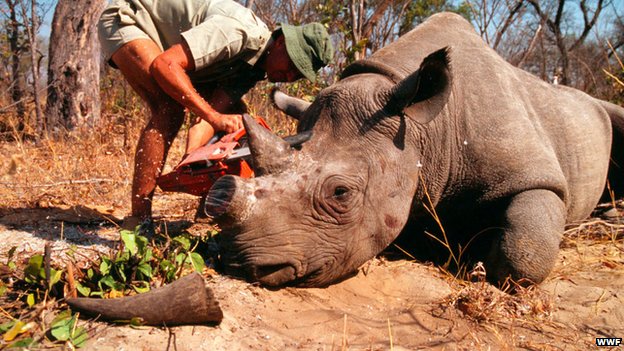
dead rhino
 
A dead rhino is dehorned by a researcher in Zimbabwe.
 

Figures from the South African government indicate that poaching for rhinoceros has increased substantially in the last year.

A record 668 rhinos were killed for their horns in 2012, up almost 50% on the number for 2011. The majority of the animals were killed in the Kruger national park, the country's biggest wildlife reserve.


“Rhinos are being illegally killed...all for the frivolous use of their horns as a hangover cure” Sabri Zain TRAFFIC  

Experts say that growing demand for rhino horn in Asia is driving the slaughter.

DR Congo employs dogs to tackle elephant poaching

Dogs training at Virunga, September 2011
Bloodhounds have begun working  with rangers at Virunga National Park to track down poachers.

Rangers in the Democratic Republic of Congo's Virunga park have a new weapon in their fight against poachers. National Park authorities have trained five bloodhound dogs to track elephant poachers after a spate of incidents. The first investigation using the dogs was carried out last week and led to the discovery of illegal weapons. Poaching is one of the key threats to the animals in Virunga, a Unesco World Heritage Site in the war-torn eastern region of DR Congo. The park is also home to gorillas, chimpanzees, okapi, forest elephants and buffalo, among other wildlife. Some 300 rangers protect the park from poachers, rebel groups and illegal miners. 'Effective weapon' Park authorities now hope the bloodhound programme, which was implemented with help from a specialised Swiss centre and volunteers from the German police, will help to protect the vulnerable elephant population from ivory poachers. The dogs and their handlers got the chance to put their training into action on 1 March, when rangers spotted a dead elephant with its tusks cut off on the edge of Virunga.

Crime chiefs agree to get tough on illegal tiger trade

Tiger (Getty Images/Panoramic Images) About 4,000 tigers are estimated to remain in the wild

Crime chiefs from countries with populations of wild tigers have agreed to work together in order to combat the illegal trade in the big cats.

Heads of police and customs from 13 nations agreed to tighten controls and improve cross-border co-operation at a two-day meeting in Bangkok. Only six subspecies remain, with fewer than 1,000 tigers in each group. Smuggling of tiger parts is one of the main threats facing the planet's remaining big cats, say experts.

Email Addresses