Languages

Grasslands

English

Grassland Habitat

Grasslands

Grasslands are regions dominated by grasses. There aren’t too many trees and shrubs here. Temperature ranges between -20°C and 30°C. The annual rainfall varies between 50 and 90 cm. Grasslands provide shelter to a large variety of animals including giraffe, zebra, lion, elephant, and gazelle.

Horrible extinction risk to plants - May 2016

Scientists have published their first global assessment of the state of the world's plants.

They warn that 21% of all plants are at risk of extinction and face a broad range of threats. The research was carried out by the Royal Botanic Gardens Kew in the UK.   See the full report:   here

Vietnamese rhino horn traffickers charged in South Africa

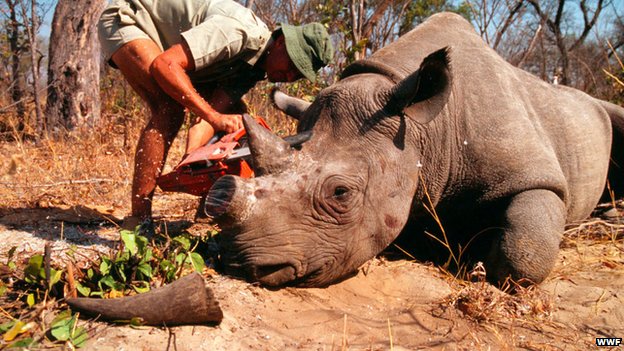
Two Vietnamese nationals in South Africa have been charged with the illegal possession of 41kg (90lbs) of rhino horn, police have told the BBC. Officials say it is the largest amount of black market rhino horn to be seized in South Africa. The men, believed to be linked to an international poaching ring, had been under surveillance before their arrest at a Johannesburg airport, police say. Nearly 900 rhino have been killed in South Africa since January. Rhino horn can sell for up to $65,000 (£47,500) per kg - which is nearly double the price of gold - with China and Vietnam being the largest markets. Police say the illegal haul was found by a dog that specialises in sniffing out rhino horn at OR Tambo International Airport in Johannesburg on Sunday. 'National crisis' Paul Ramaloko, spokesperson for South Africa's organised crime fighting unit, told the BBC it was equivalent of 20 rhino horns with an estimated value of $358,000. Some South Africans have staged protests calling for more action against poaching. "Rhino poaching is regarded as a national crisis - for this reason those found guilty of the crime are dealt with harshly," he said. It is believed that the horns were most likely to have been removed from animals in South Africa's Kruger National Park, but tests need to be done to determine their origin, officials say.

Africa Elephants endangered - survival threat due to poaching

African elephants endangered species illegal poaching ivory trade
illegal poaching ivory trade China killing endangered african elephant

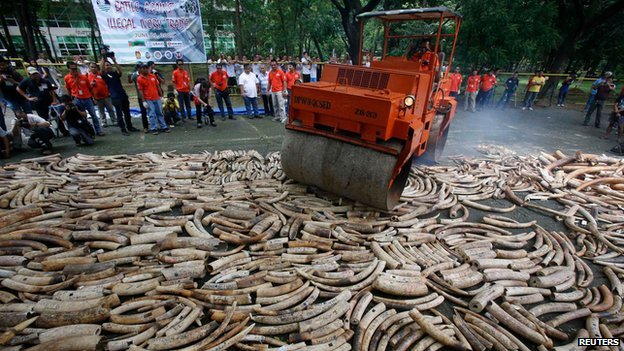
Africa elephants 'face survival threat' from poaching. Elephant conservationists say demand for ivory remains high. The survival of Africa's elephants is under threat, with estimates suggesting more than 20,000 were killed in 2013, a report says. The office of the Convention on International Trade in Endangered Species (Cites) said poaching levels were far above the elephant birth rate. However, the report said poaching numbers had dropped slightly compared to the previous two years. Transnational organised crime appeared to be involved in the trade, it added. Cites, which is based in Geneva, is responsible for regulating the international trade in more than 35,000 species of plants and animals. Ivory tusks and products are displayed after the official start of the destruction of confiscated ivory in Hong Kong 15 May 2014 China has started to destroy seized ivory in public There are a number of interesting signals in these latest figures, perhaps indicating that the tougher line being taken by Cites is bearing fruit. For the first time, more large-scale consignments of ivory have been seized in Africa rather than in Asia. This is down to better policing in Kenya, Tanzania and Uganda and perhaps a slight downturn in demand from the key markets such as China, which carried out the first public destruction of ivory earlier this year. There is also the rise in demand in China for legal mammoth ivory that is mainly exported from Russia, which may also indicate a growing awareness of the connection to elephants and a willingness to look at alternatives.

Organised crime and Asian superstition driving rhinos and elephants to extinction

Ivory destruction Despite efforts to destroy ivory, criminals are becoming more organised, ingenious and dangerous. "We have seen more and more organised crime networks moving into the wildlife trade," says Davyth Stewart from Interpol, the international intelligence agency. "Groups who have been traditionally involved in drug trafficking, fire arms and human trafficking are now moving onto wildlife." It's clearly not a fair match: conservationists pitted against criminal gangs. But the wildlife experts say it's a fight they have to take on. They have gathered at the Zoological Society of London to tackle how to halt the rapidly growing trade in animals. The backdrop to these crisis talks is bleak. Thousands of rhinos, elephants, tigers and others have been slaughtered, becoming part of an illegal market that's worth an estimated $19bn a year. Many criminals see it as low risk, high profit, says Mr Stewart. "There is a lower risk of apprehension, it's unfortunate but law enforcement has not invested the resources in attacking wildlife crime as it has in other crimes," he explains. "Even in courts the penalties are much lower. Just last year in Ireland, we saw two people arrested for smuggling rhino horns worth half a million euros. They received a 500-euro fine." Demand and supply John Sellar, the former chief of enforcement at Cites (the Convention on International Trade in Endangered Species), says the focus of the battle should be shifted away from conservation towards the issue of criminality. "It's about locking up the bad guys," he tells the conference.

Farming impact on Global Warming

Changing the way farmers plough their lands could have a big impact on global emissions of greenhouse gases. Changing farming practices could play an important role in averting dangerous climate change says the UN. In their annual emissions report, they measure the difference between the pledges that countries have made to cut warming gases and the targets required to keep temperatures below 2C. On present trends there is likely to be an annual excess of 8 to 12 gigatonnes of these gases by 2020. Agriculture, they say, could make a significant difference to the gap. This is the fourth such report, compiled by the United Nations Environment Programme (Unep) in conjunction with 44 scientific groups in 17 countries. It says the world needs to reduce total emissions to 44 gigatonnes of carbon dioxide equivalent by 2020 to keep the planet from going above the 2C target, agreed at a UN meeting in Cancun in 2010. But when all the pledges and plans made by countries are added together, they show an excess of between 8 and 12 gigatonnes per annum in seven years time, very similar to last year's report. To put it in context, 12 gigatonnes is about 80% of all the emissions coming from all the power plants in the world right now. The authors highlight a number of ways in which this gap can be closed, including tightening the rules for counting emissions and expanding the scope of pledges already made. They believe around half the gap could be closed in this way.

Project to protect rare Burmese monkey gets new funding

Burmese snub-nosed monkey photographed by a camera trap
Burmese snub-nosed monkey photographed by a camera trap in May 2011
 

A conservation project to help

protect the rare Burmese snub-nosed monkey is one of 33 to get a share of UK Government funding. The species was photographed for the first time last year. The project, led by Fauna and Flora International (FFI), will try to establish how many of the monkeys are left and how best to protect them. The money comes from a long-term scheme called the Darwin Initiative. The Burmese snub-nosed monkey was described scientifically for the first time in 2010 from a dead specimen collected by a local hunter. In May 2011 researchers working in northern Burma captured the first pictures of the species in its natural habitat. A team from FFI, Biodiversity and Nature Conservation Association (Banca), and People Resources and Conservation Foundation (PRCF) took the images using camera traps.


Big Cats - Mountain Lions, Panthers, Jaguars, Tigers and Cheetahs

Of the nearly forty feline, or cat, species, only one—the domestic cat—is believed to be secure. As undeveloped land becomes harder to find, large cats, such as lions, panthers, tigers, jaguars, and cheetahs, are left with less and less natural habitat in which to live.

Big Cat Species facing Extinction

Big Cat Species Facing Extinction 2010 was supposed to be the Year of the Tiger. Unfortunately, tigers, lynx, jaguars, leopards, lions, pumas, cheetahs, and every species of Big Cat in the world is in decline. How long these magnificent species can evade extinction is up to us. Big Cats are part of the Family Felidae (or feline), and are a rich addition to our natural world. However, the Big Cats are in severe decline throughout the planet. The Anthropocene Extinction, also known as the Holocene Extinction event, is the world’s 6th great sudden loss of life. We are currently in the third wave of this, and man-made ecological effects such as an overexploitation of species, pollution, the introduction of alien species, and habitat encroachment are directly responsible for the decline and extinction of thousands of species of life.

Email Addresses