Languages

2013

English

Indonesia surpasses Brazil in deforestation rate

deforestation-indonesia-2013.jpg This photo taken on 13 November 2013 shows a timber company's vehicle driving down a dirt road in the forests of in Berau, East Kalimantan. Researcher say deforestation has led to an increase in greenhouse gas emissions and a loss of Indonesia's biodiversity. A new study has shown that Indonesia lost about 60,000 sq km of virgin forest - an area close to the size of Ireland - over a period of 12 years. The rate of deforestation has increased so much that Indonesia has for the first time surpassed Brazil in the rate of its clearance of tropical forests. The study was published in the journal Nature Climate Change. Scientists monitored the growth of deforested land in Indonesia between 2000 and 2012 using satellites. indonesia-sattelite-image-riau-deforestation.jpg Picture of Riau province's rate of deforestation. Satellite imagery of Indonesia's Riau province showed wetland forest loss (in red) and forest degradation (in blue) over the study period They say the land was cleared to make way for palm oil plantations and other farms. By 2012, the loss of primary forest every year in Indonesia was estimated to be higher than that in Brazil, said scientists. In that year, Indonesia lost 8,400 sq km of forest compared to Brazil which lost 4,600 sq km.

Amazon and Global Deforestation rose in 2013

Brazil says Amazon deforestation rose 28% in a year

Brazil Environment minister Izabella Teixeira
Minister Izabella Teixeira says she will tackle the problem with local authorities.

Brazil says the rate of deforestation in the Amazon increased by 28% between August 2012 and last July, after years of decline. The government is working to reverse this "crime", Environment Minister Izabella Teixeira said. Activists have blamed the increase in destruction on a controversial reform to Brazil's forest protection law. Last year Brazil reported the lowest rate of deforestation in the Amazon since monitoring began. The provisional statistics from August 2012 to last July suggest that the area suffering deforestation was 5,843 sq km (2,255 sq miles), compared to 4,571 sq km (1,765 sq miles) in the previous 12 months. The 28% rise interrupts a period of declining deforestation which began in 2009. However, it still remains the second lowest annual figure for forest loss in absolute terms. The worst year on record was 2004, when 27,000 sq km of forest was destroyed. Monthly data from several scientific institutions had suggested the deforestation rate might be on the rise.

2013 warmest year

2013 warmest on record


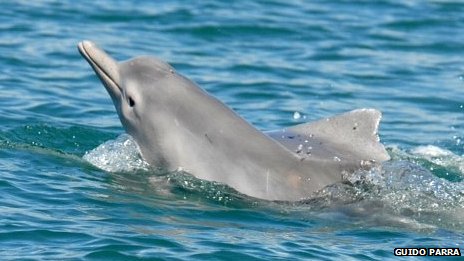
New species of dolphin identified - 2013

New species of dolphin identified. A team of researchers says it has identified a new species of humpback dolphin. Physical and genetic evidence suggests that cetaceans found in waters off northern Australia are distinct within the humpback family. This general group grows up to 2.4m in length and inhabits coastal waters from the Atlantic to the Pacific. The evidence for the distinct species in northern Australia is outlined in the academic journal Molecular Ecology. "Based on the findings of our combined morphological and genetic analyses, we can suggest that the humpback dolphin genus includes at least four member species," said co-author Martin Mendez, from the Wildlife Conservation Society's Latin America and the Caribbean programme. Dr Mendez added: "This discovery helps our understanding of the evolutionary history of this group and informs conservation policies to help safeguard each of the species." New species scheme for humpback dolphins: Atlantic humpback dolphin (Sousa teuszii), which occurs in the eastern Atlantic off West Africa An Indo-Pacific humpback dolphin (Sousa plumbea), which ranges from the central to the western Indian Ocean Another species of Indo-Pacific humpback dolphin (Sousa chinensis), inhabiting the eastern Indian and western Pacific Oceans Fourth Sousa species found off northern Australia yet to be named The authors analysed physical data gathered mostly from beached dolphins and museum specimens.

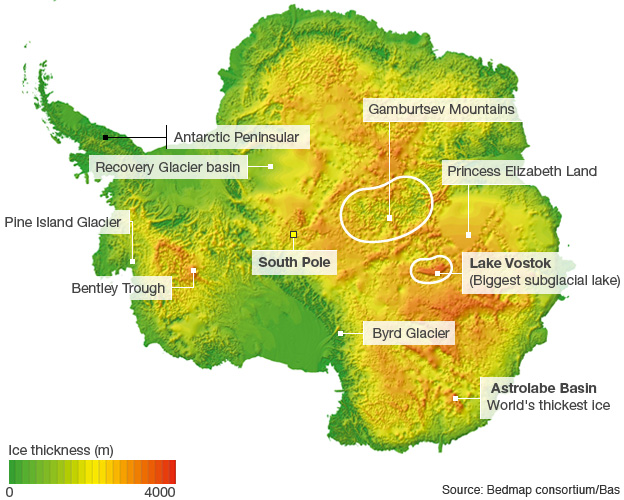
2013 estimate of 2100 sea level rise due to melting ice

Antarctica-ice-thickness-2013

'Best estimate' for impact of melting ice on sea level rise Researchers say they now have the most accurate estimate yet for the impact of the melting of ice sheets. Researchers have published their most advanced calculation for the likely impact of melting ice on global sea levels. The EU funded team say the ice sheets and glaciers could add 36.8 centimetres to the oceans by 2100. Adding in other factors, sea levels could rise by up to 69 centimetres, higher than previous predictions. The researchers say there is a very small chance that the seas around Britain could rise by a meter. “The previous IPCC identified this gap in our knowledge, we've addressed that gap and what we've found is not scary” Prof Tony Payne, University of Bristol The last Intergovernmental Panel on Climate Change (IPCC) report was highly detailed about many aspects of Earth's changing climate in the coming decades, Advanced models While they estimated that sea levels could rise by 18-59 centimetres by 2100, they were very unsure about the role played by the melting of ice sheets and mountain glaciers. To fill the void, the EU funded experts from 24 institutions in Europe and beyond to try and come up with more accurate figures on the melting of ice sheets and glaciers in Antarctica and Greenland and how this might swell the oceans. Called Ice2sea, the group of scientists have made what they term the "best estimate" yet of the impact of melting based on a mid-range level of carbon emissions that would increase global temperatures by 3.5C by the end of this century.

Arctic Ocean is acidifying rapidly

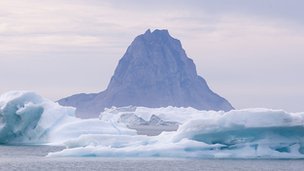
Arctic - Saunders Island and Wolstenholme Fjord with Kap Atoll
arctic volcano

Arctic Ocean 'acidifying rapidly' Photo1: Saunders Island and Wolstenholme Fjord with Kap Atholl in the background is shown in this picture taken during an Operation IceBridge survey flight in April 2013. Photo 2: arctic volcano. The Arctic seas are being made rapidly more acidic by carbon-dioxide emissions, according to a new report. Scientists from Norway's Center for International Climate and Environmental Research monitored widespread changes in ocean chemistry in the region. They say even if CO2 emissions stopped now, it would take tens of thousands of years for Arctic Ocean chemistry to revert to pre-industrial levels. Many creatures, including commercially valuable fish, could be affected. They forecast major changes in the marine ecosystem, but say there is huge uncertainty over what those changes will be. It is well know that CO2 warms the planet, but less well-known that it also makes the alkaline seas more acidic when its absorbed from the air.

African Elephant Poaching 2013

African elephant poaching threatens wildlife future.

Slain elephants, Tsavo National Park, Kenya
 
Kenya has strong anti-poaching regulations - yet still elephants die.
 

Three elephant corpses lay piled on top of one another under the scorching Kenyan sun.

Email Addresses